
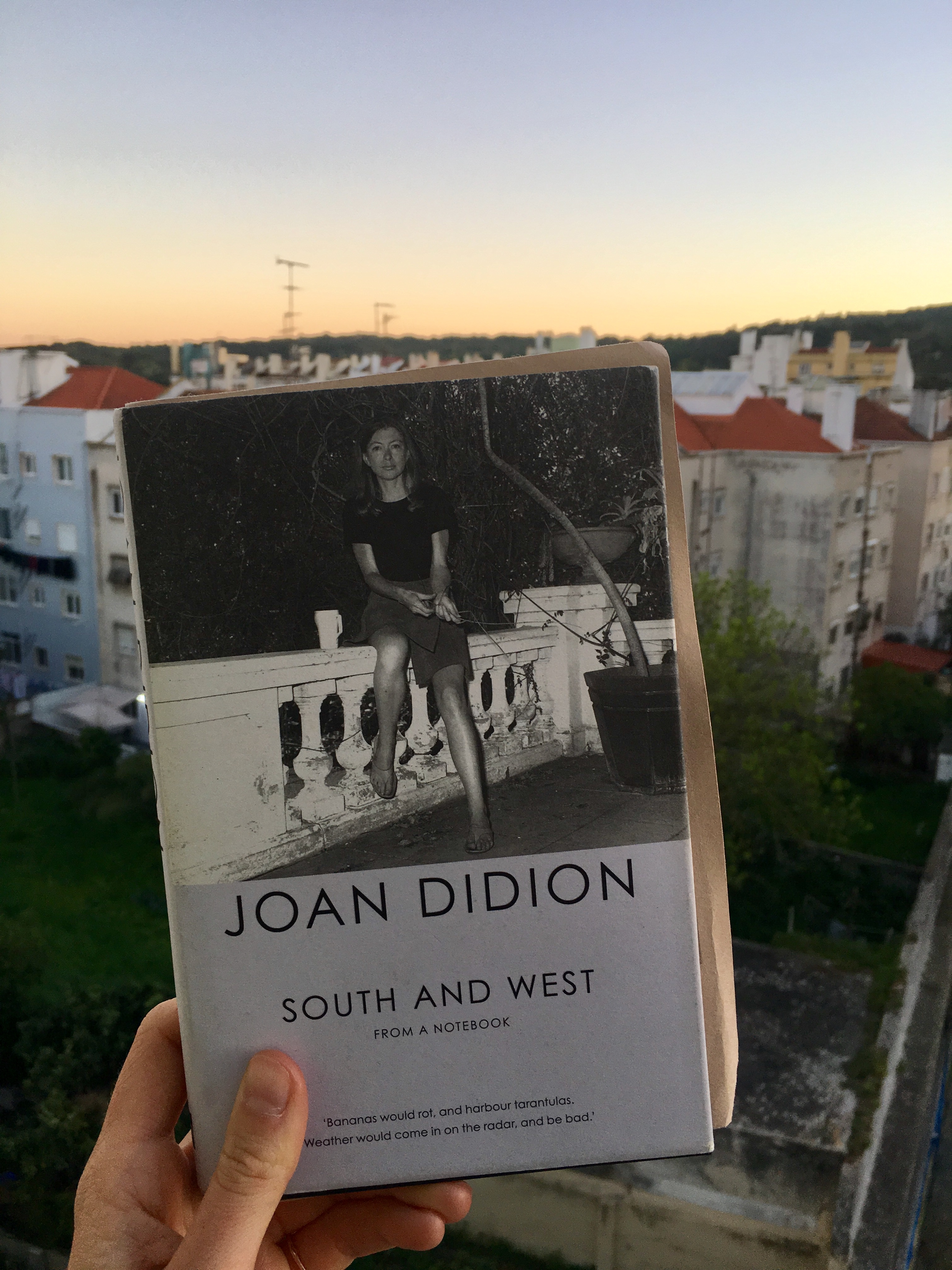
I finished Joan Didion’s most recent publication, South and West: From a Notebook, at a café in Lisbon, 4,000 miles away from the author’s subject matter: the American South. The book has its origins in a trip Didion took with her husband, writer John Dunne, in the summer of 1970; and, despite having no clear reportorial motive, Didion purports to have been drawn to the South by some “dim and unformed sense…that the South had been for America what people were still saying California was…the future, the secret source of malevolent and benevolent energy, the psychic center.”
Though Didion recorded the notes that would make up South and West in 1970, the book wasn’t published until nearly forty years later, in 2017. This four-decade gap between the recording and the release of the notes was witness to political and social change that altered the very fiber of what it means to be American; of what it means to be a Southerner; and of what it means to be a writer.
Following its publication, critics lauded South and West as a book of prophecy–a cultural premonition of what was in store for our country: the election of a populist bully to the presidency, the rise of white nationalism, and the vicious backlash that often follows social progress. In the New York Times review of South and West, Michiko Kakutani claims that Didion successfully “maps the divisions splintering America today,” and “anticipates some of the dynamics that led to the election Donald J. Trump.”
Starting in New Orleans, where the air was “heavy with sex and death,” Didion begins her quest: to record, to inhabit, and, ultimately, to connect to the essence of this foreign landscape. In Louisiana, “Bananas would rot…Weather would come in on the radar, and be bad.” In Mississippi, “Everything seems to go to seed along the Gulf: walls stains, windows rust. Curtains mildew. Wood warps.” In Alabama, “It seemed a good and hopeful place to live, and yet the pretty girls, if they stayed around Guin, would end up in the laundromat in Winfield, or in a trailer with the air-conditioning on all night.”
Didion’s observations imbue the South with a spirit of doom, a fatalism she ties to its ever-present history–a past that, even in contemporary Southern culture, often evokes both shame and reverence. As she makes her way across a landscape marked by “decay, overripeness…[and] suffocation,” Didion draws attention to the moral and political failings of Southern culture: blatant racism, sexism, and inequality. Didion describes New Orleans as having a “dense obsessiveness…with race, class, heritage, style, and the absence of style” that lends the local conversation a “childlike cruelty and innocence.” In a trinket shop, she buys a beach towel printed with a Confederate flag. In sparse towns, she talks to women: a hairdresser married at seventeen who lives in a trailer, a waitress ignorant of the existence of iced coffee, the housewives who are bewildered by the idea of a woman choosing to drive a car.
As a native of Kentucky, I’m a reader who is well-acquainted with the historical and contemporary failings of the South. The fact that the South is plagued by rampant poverty, that Southern women operate daily within a highly misogynistic culture, and that explicit racism is alive and well is, quite frankly, no news to me (and I doubt these observations would have passed as news in the 70’s, either). In my opinion, Didion’s notes offer no new prism through which to view these issues. They offer no new nuance. And, as they are usually paired with a sense of elitism bordering on common snobbery (re: Southerners are racist and consider the Holiday Inn to be fine dining), these observations are often chokingly condescending.
Thus, even with the advantage of geographical distance (and nearly half a bottle of Portuguese wine), I found myself in an almost bodily opposition to the piece. Didion’s account of the South felt uncomfortably close and unbearably simplistic. I reddened at her descriptions of places where the people spoke in accented, slow voices and were dumbfounded by a woman in a two-piece bathing suit. I cringed at the connections Didion seems to make between style and morality, as if there were an inextricable link between eating dinner at 6:30 p.m. (hours before anyone would even think to dine in the West) and the mistreatment of women (not to mention the lack of opportunity available to women of color in Southern states).
What Didion offers to America is a caricature of the South, feeding the image of the redneck, the nationalist, and the classless Southerner. In response, the press was quick to posit South and West as both a premonition and explanation of the 2016 presidential election: i.e. these are the people who elected Donald Trump. Though I can’t speak to Didion’s motives, I can say with confidence that the effect of her portrait of the South is an “othering” that, though it grants a sense of (intellectual, ethical, and cultural) superiority to anyone living outside those Southern states, doesn’t effectively address the complex misgivings of Southern politics and culture.
The individual conclusions Didion draws from her observations may indeed be true: even today, people do eat dinner at an ungodly, early hour in the South, and women are treated like second-class citizens. Yet, I resent the link that Didion–or perhaps the blame lies more with the press’s reaction to the book–seems to propose between the two. The contemporary South is not propagating racist, nationalist rhetoric because of its tackiness (though on the subject of dining hours, I think we can all objectively agree that eating an early dinner is better for digestion). Thus, Didion’s comments about real, tangible issues are undermined by her not-so-subtle mockery of the South.
If I find any redemption in South and West it is in its sense of timelessness. I blushed in shame upon reading the piece because I recognized, and identified, with problems laid out in Didion’s notes; any Southerner will attest to the fact that many of her observations still hold true today. In the forty years since these notes were taken, not enough has changed in the South. There has not been enough movement. Not politically, nor socially.
South and West may not provide a blueprint for how we got here (or for how he got there), and it certainly does not paint an accurate, un-biased portrait of the South. But, reading this book does serve as a timely reminder; it shows that there is work yet to be done. There are valid (and potentially unanswerable) questions to be asked about the problems in the South. There are discussions to be had. There are books to be written. And, much to my delight, there are books to be read.*
*(I recommend sociologist Arlie Hochschild’s Strangers in Their Own Land, if you’re interested).
 A Lighted Room