
Enough of the Right Things

About a year ago I read Deborah Levy’s memoir The Cost of Living: A Working Autobiography in one full sitting. At the time, I was staying at my parents’ house, alternatively feeling comforted and startled by (bless them) what seemed to be an unspoken, collective bedtime of 8 p.m. One night, left to my own devices at ten till eight, I decided to rifle through my dad’s bourbon cabinet and open Levy’s book. 

I’d enjoyed reading Levy’s fiction (particularly her eerily beautiful novel Swimming Home), but this was my first dip into her nonfiction. Unsurprisingly, having read it over a year ago, I don’t remember many of the memoir’s specifics, but one of Levy’s expressions struck such a chord with me that, to this day, her words still pop into my head. At around the midway point in the book, as Levy is reeling from the fallout of a divorce, her children leaving home, and the shock of her new life as a single, middle-aged writer, she comes to the realization that what she needs is enough of the right things

Enough of the right things. Upon reading those words, my first reaction was to interrogate them: What are the right things? How do you define ‘enough?’ Is she implying we should all settle? But, before I could completely tear apart Levy’s sentiment with my logic-hounding, I had a secondary reaction: I felt, deeply, that these words were somehow staggeringly solid, and true. 

To the outside observer, my life probably looks relatively seamless (we can all thank social media for that, I suppose), and by all accounts I have been extremely fortunate. But…there’s always a but, and this is mine: I’ve spent a significant part of my twenties lining up all of the things I need to do, achieve, or master before I can begin to live a fulfilled life. Even if you’ve been living under a rock, sheltered from the rain of modern self-help articles (and podcasts! and newsletters!), you most likely understand that a fulfilled life is composed of more than the satisfaction of filing away a shining, tidy checklist. But there’s often a frustratingly wide gap between understanding a concept and living it. 

Levy’s words were a stark reminder of this gap that stretches between comprehension and action; through her journey of identifying and executing “enough of the right things,” Levy was demonstrating the active, contemplative nature of composing a meaningful life. Levy’s “right things” were often simple: cooking dinner for her daughter, writing into the night, a small apartment she could call her own. Everyone’s life reads as a narrative in the mind, and Levy was leveraging her understanding of story to re-write portions of hers. Through her efforts to unearth what is truly valuable in her life, Levy calls attention to the symbiotic relationship between our life’s circumstances and what we tell ourselves about them.

As my parents snored on in the next room, Levy’s words were a call to action to name the “right things” in my own life. And I found that seeking out “enough of the right things,” is twofold.

First, the identifying and executing. Ever since I read Mary Oliver’s assertion that “attention is the beginning of devotion,” I’ve made an effort to write down the things I give my attention to (and, thus, my devotion). Here’s the short-list: being in communion with others (family, friends, coworkers, fellow mid-winter, bundled-to-the-brim outdoor café-goers), walking beneath trees, cooking the same vegetables seven different ways each week, running at dusk, reading, writing, having a few early morning hours to myself, exploring tiny Portuguese villages with my partner, building a loving home, watching my dog frolic on the beach. These are my “right things,” though I often overlook them.

One of the reasons we put limitations on our satisfaction with life (I’ll be happier when I get that job, I’ll be able to enjoy life once I’ve made enough money, I’ll have the life I want when I’m older) may be because we’re actually quite frightened by the idea that we already have “enough.” What would be left of our lives without all the striving towards future happiness? What pieces of it would bear the weight of the present? And if they aren’t simply a linear progression, then what shape do our lives really take? And, of course, all of these questions are complicated by the fact that many people in the world still don’t have nearly “enough” resources (such as time, basic necessities, and safety) to choose or cultivate their own “right things.”

Which brings me to the second part of my seeking “enough of the right things.” To have the luxury–and privilege–to pursue my interests and compose a peaceful life is not enough in and of itself; this privilege comes with obligation. To try to untie, as much as I can, the tangled webs of oppression, racism, and classism that are inherent to our current social, economic, and political structures. Through learning, teaching, voting, counseling, cultivating friendships, being present in my community, and through active listening, I hope to address the obstacles that prevent others from seeking their own “right things.” I know that unless I help others obtain that freedom, I will never reach the fullest, ripest, most connected version of my own life.

The Cost of Living was a reminder that we’re all always writing our “working autobiographies,” regardless of whether we’re putting them to paper. To fill your autobiography-in-process with “enough of the right things” requires contemplation and action, and I believe we’re bound to share that abundance with others. In short, to steal another Mary Oliver quote, I aim to “Pay attention. / Be astonished. / Tell about it.”
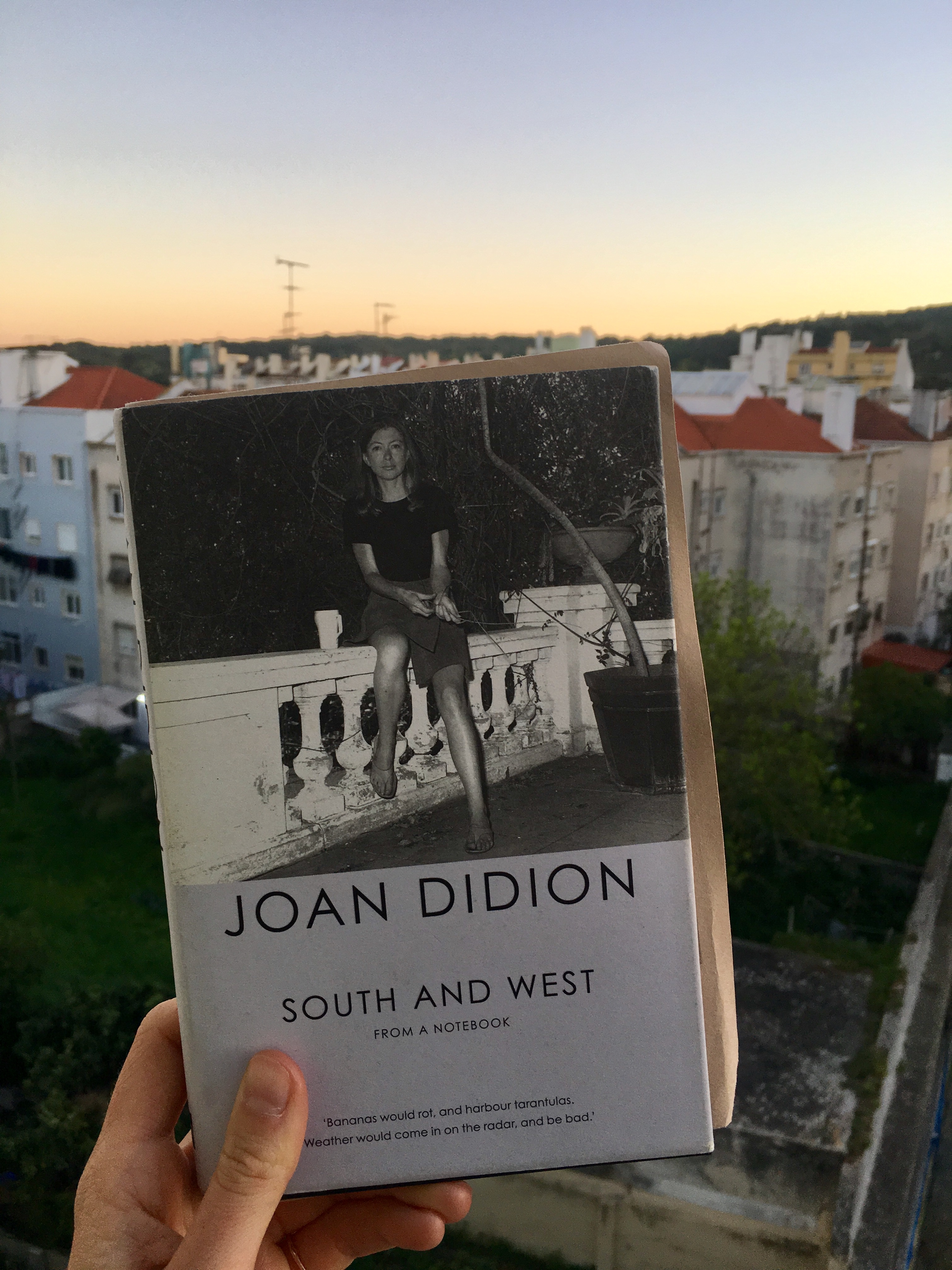
South and West, From a Notebook: Joan Didion

I finished Joan Didion’s most recent publication, South and West: From a Notebook, at a café in Lisbon, 4,000 miles away from the author’s subject matter: the American South. The book has its origins in a trip Didion took with her husband, writer John Dunne, in the summer of 1970; and, despite having no clear reportorial motive, Didion purports to have been drawn to the South by some “dim and unformed sense…that the South had been for America what people were still saying California was…the future, the secret source of malevolent and benevolent energy, the psychic center.”

Though Didion recorded the notes that would make up South and West in 1970, the book wasn’t published until nearly forty years later, in 2017. This four-decade gap between the recording and the release of the notes was witness to political and social change that altered the very fiber of what it means to be American; of what it means to be a Southerner; and of what it means to be a writer.

Following its publication, critics lauded South and West as a book of prophecy–a cultural premonition of what was in store for our country: the election of a populist bully to the presidency, the rise of white nationalism, and the vicious backlash that often follows social progress. In the New York Times review of South and West, Michiko Kakutani claims that Didion successfully “maps the divisions splintering America today,” and “anticipates some of the dynamics that led to the election Donald J. Trump.”

Starting in New Orleans, where the air was “heavy with sex and death,” Didion begins her quest: to record, to inhabit, and, ultimately, to connect to the essence of this foreign landscape. In Louisiana, “Bananas would rot…Weather would come in on the radar, and be bad.” In Mississippi, “Everything seems to go to seed along the Gulf: walls stains, windows rust. Curtains mildew. Wood warps.” In Alabama, “It seemed a good and hopeful place to live, and yet the pretty girls, if they stayed around Guin, would end up in the laundromat in Winfield, or in a trailer with the air-conditioning on all night.”

Didion’s observations imbue the South with a spirit of doom, a fatalism she ties to its ever-present history–a past that, even in contemporary Southern culture, often evokes both shame and reverence. As she makes her way across a landscape marked by “decay, overripeness…[and] suffocation,” Didion draws attention to the moral and political failings of Southern culture: blatant racism, sexism, and inequality. Didion describes New Orleans as having a “dense obsessiveness…with race, class, heritage, style, and the absence of style” that lends the local conversation a “childlike cruelty and innocence.” In a trinket shop, she buys a beach towel printed with a Confederate flag. In sparse towns, she talks to women: a hairdresser married at seventeen who lives in a trailer, a waitress ignorant of the existence of iced coffee, the housewives who are bewildered by the idea of a woman choosing to drive a car.

As a native of Kentucky, I’m a reader who is well-acquainted with the historical and contemporary failings of the South. The fact that the South is plagued by rampant poverty, that Southern women operate daily within a highly misogynistic culture, and that explicit racism is alive and well is, quite frankly, no news to me (and I doubt these observations would have passed as news in the 70’s, either). In my opinion, Didion’s notes offer no new prism through which to view these issues. They offer no new nuance. And, as they are usually paired with a sense of elitism bordering on common snobbery (re: Southerners are racist and consider the Holiday Inn to be fine dining), these observations are often chokingly condescending.

Thus, even with the advantage of geographical distance (and nearly half a bottle of Portuguese wine), I found myself in an almost bodily opposition to the piece. Didion’s account of the South felt uncomfortably close and unbearably simplistic. I reddened at her descriptions of places where the people spoke in accented, slow voices and were dumbfounded by a woman in a two-piece bathing suit. I cringed at the connections Didion seems to make between style and morality, as if there were an inextricable link between eating dinner at 6:30 p.m. (hours before anyone would even think to dine in the West) and the mistreatment of women (not to mention the lack of opportunity available to women of color in Southern states).

What Didion offers to America is a caricature of the South, feeding the image of the redneck, the nationalist, and the classless Southerner. In response, the press was quick to posit South and West as both a premonition and explanation of the 2016 presidential election: i.e. these are the people who elected Donald Trump. Though I can’t speak to Didion’s motives, I can say with confidence that the effect of her portrait of the South is an “othering” that, though it grants a sense of (intellectual, ethical, and cultural) superiority to anyone living outside those Southern states, doesn’t effectively address the complex misgivings of Southern politics and culture.

The individual conclusions Didion draws from her observations may indeed be true: even today, people do eat dinner at an ungodly, early hour in the South, and women are treated like second-class citizens. Yet, I resent the link that Didion–or perhaps the blame lies more with the press’s reaction to the book–seems to propose between the two. The contemporary South is not propagating racist, nationalist rhetoric because of its tackiness (though on the subject of dining hours, I think we can all objectively agree that eating an early dinner is better for digestion). Thus, Didion’s comments about real, tangible issues are undermined by her not-so-subtle mockery of the South.

If I find any redemption in South and West it is in its sense of timelessness. I blushed in shame upon reading the piece because I recognized, and identified, with problems laid out in Didion’s notes; any Southerner will attest to the fact that many of her observations still hold true today. In the forty years since these notes were taken, not enough has changed in the South. There has not been enough movement. Not politically, nor socially.

South and West may not provide a blueprint for how we got here (or for how he got there), and it certainly does not paint an accurate, un-biased portrait of the South. But, reading this book does serve as a timely reminder; it shows that there is work yet to be done. There are valid (and potentially unanswerable) questions to be asked about the problems in the South. There are discussions to be had. There are books to be written. And, much to my delight, there are books to be read.*

*(I recommend sociologist Arlie Hochschild’s Strangers in Their Own Land, if you’re interested).

Amor: Clarice Lispector


Glamour. Restlessness. Mysticism. Clarice Lispector’s reputation precedes her. Having risen through the ranks of Brazil’s literary elite at age twenty-three, she is coveted as one of the country’s most brilliant, prolific authors. Her stories are fierce, tender and haunting; her persona arresting.

In 2015, New Directions Publishing put out a beautiful, hefty collection of Lispector’s complete stories, translated from the original Portuguese by Katrina Dodson. This publication marks the first time, in any language, that all of Lispector’s stories have appeared in the same collection. The result is a spell-binding, gut-wrenching glimpse into the life of the modern woman in the latter half of the twentieth century.

Lispector’s women span from teenage girls bristling with youth to elderly matriarchs who simply want, more than anything, to be left the hell alone. Her women are not the “universal woman”; these women are, for the most part, firmly situated in Brazil’s upper middle class and beyond. However, each of the women in Lispector’s stories begets a similar, and painfully timeless, question: As a woman, as a mother, as a person, why do I want what I want? Are my desires truly my own?

None of her stories better encapsulates this line of questioning than “Amor,” published in 1960. In “Amor,” we follow Ana, a woman pacing: from the stifling apartment, to her “comprehensible, adult life,” to the “unstable hour” of the afternoon when there are no more chores to be done, to the growth of her children, and to the tram she boards with a knit-sack stretched with groceries. She cultivates an ordered life–within which she has purpose and boundaries–and has “taken such care for it not to explode.”

It’s aboard this tram that all of Ana’s work, the life that she had “wanted and chosen,” unravels. She sees a blind man chewing gum.

Her eyes locked on the blind man, Ana comes undone. A violent compassion rising to the surface. His lack dislodges something inside of Ana–suddenly she craves color, and texture, and movement; she’s overwhelmed by something forgotten: a youthful lust for the world.

Back on solid ground, Ana walks through a grotesquely vivid garden–both literally and figuratively–feeling nauseated and fascinated. Rotting fruit, a sleek, powerful cat. An instant of raw emotion sparked by a stranger had made her life of order, of duty, seem like a “morally insane way to live.” For a moment, she was plunged back into the sticky, hot reality of the world outside of her foyer, her children, her husband. For a moment, love flexed, expanded.

Re-connected to the world, Ana feels–desire, despair, fear, joy. After so many years of caution, Ana abandons herself to youth’s illness: she was filled with the “worst desire to live.” Fully awake, the bright cleanliness of her apartment burns her eyes. Why had she wanted this life? Why had she chosen it? This, the explosive, often unanswerable, query of the modern woman.

Her children return to the apartment, her friends seat themselves around the dinner table, her husband’s arms encircle her–slowly, the shock of the day recedes. Finally, Ana’s desire is laid to rest as her husband leads her to the bedroom, “removing her from the danger of living.”

In “Amor,” as in many of her other stories, Lispector touches a nerve–a woman pinched between chaos / order, desire / duty, choice / obligation. Ana is the incarnation of the status quo–acceptance without examination.

Until she sees the blind man. Until her guard is yanked down, unwillingly lowered. Until she allows herself to want.

In the end, Ana returns to the familiar; to a life without questions, only pre-ordained answers. In the span of a summer afternoon, she had “passed through love and its hell,” before settling back into her curated world. Love as presence, as compassion, as pain. That evening, Ana does what countless other women did, and to today, to continue the life she’s chosen: “as if putting out a candle, she blew out the little flame of the day.”

This story moved me greatly. I can’t exactly relate to a straight, married woman living in Brazil in the 60’s, but I can (and can’t help but to) connect with Lispector’s narrative, and style.

Lispector’s language is a bodily language–and one that is felt bodily upon reading. Her use of repetition, homemade grammar, and striking imagery all collaborate to unlock a character’s body, and mind. The unlocking of Ana–of her desires, fears, limitations–unlocks something in the reader, as well.

This story is a flame–a familiar one. And, fortunately, it’s getting harder and harder, at the end of the day, to put it out.